For many years, the term “high yield” was synonymous with “junk” evoking memories of the leveraged buyout boom of the 1980s, the dot-com collapse, and highly volatile, speculative issuers.
However, over the past twenty years, the global high yield market has undergone a structural transformation. Driven by the influx of “fallen angels” a significant expansion in market size, and the migration of riskier borrowers into private credit, today’s market bears little resemblance to its earlier form. It is now a more mature, institutionalized, and higher-quality asset class than at any point in its history.
The most striking piece of evidence for this evolution is the improvement in overall credit quality. Historically, the high yield universe was dominated by B- and CCC-rated issuers –companies typically characterised by lower profitability and higher sensitivity to economic cycles. In the early 2000s, BB-rated bonds (the highest tier of non-investment grade) represented less than 40% of the market.
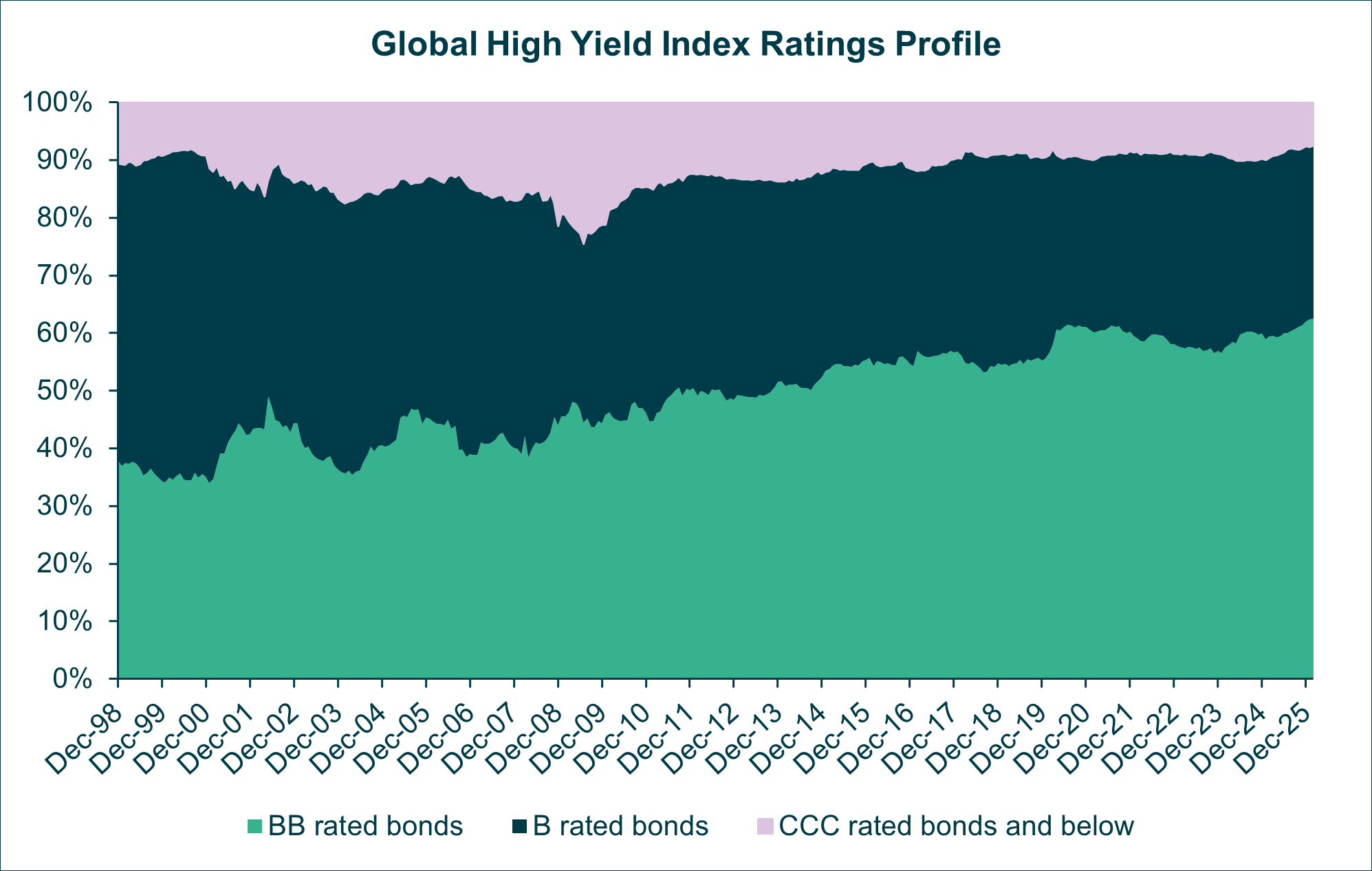
Source: ICE BofA as of February 28, 2026
Today, that figure has climbed to approximately 60%. This shift isn’t just a statistical quirk; it reflects a meaningful change in the profile of the “average” issuer. BB-rated companies are often larger, more diversified businesses with significant assets and established cash flows. Many are ‘Fallen Angels’ former investment grade companies that were downgraded during periods of stress.
As a result, the overall risk profile of the asset class has evolved.. A market with a higher concentration of BB-rated issuers tends to exhibit lower default risk and more stable behaviour than the “junk” market of the 1990s, acting less like a proxy for equities and more like a hybrid asset class offering income with moderated volatility..
Another important structural driver of the cleansing of the public high yield market has been the rapid growth of private credit. In previous cycles, the only option for many sub-investment grade borrowers was to rely on public high yield markets for financing. Today, many of the more leveraged borrowers or complex issuers have migrated to private markets, attracted by its more flexible lending terms and risk seeking lenders.