It has become common wisdom that factor-based replication is a top-down approach while risk premia strategies are bottom-up. Factor models, so the story goes, assume hedge fund returns can be explained by broad, observable exposures such as equities, rates, currencies, or commodities. Risk premia strategies, by contrast, are constructed from the bottom up, assembling portfolios of individual building blocks such as carry, momentum, or volatility selling.
This classification is sensible when viewed through the lens of portfolio construction. But when we shift the focus to model risk, the picture reverses. Factor replication, far from being “top-down,” actually allows risk to flow upward from the data. Risk premia, meanwhile, is more prescriptive, embedding the designer’s risk views at the modeling stage.
Construction Logic vs. Model Risk
Comparison of Approaches
Factor-Based Replication
Top-down: broad factors explain hedge fund returns
Risk Premia Strategies
Bottom-up: micro-strategies aggregated into a portfolio
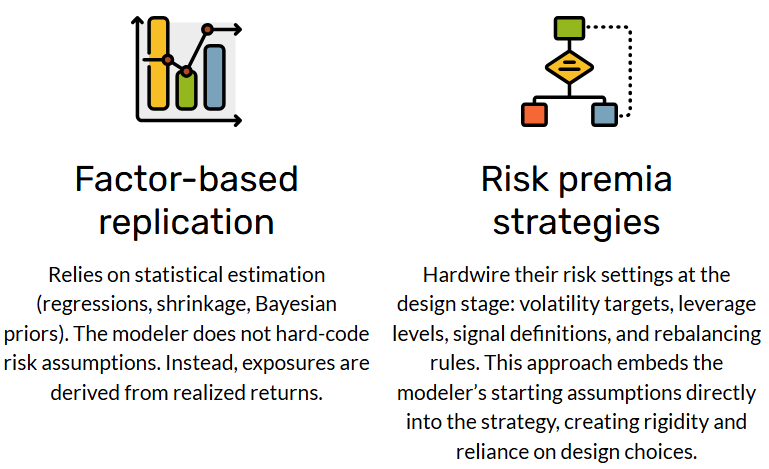
Factor-Based Replication
Estimate exposures statistically; portfolio driven by realized data
Risk Premia Strategies
Explicitly design trade rules; portfolio driven by modeler’s assumptions
Factor-Based Replication
Minimal prescriptive parameters; risk flows upward from data
Risk Premia Strategies
Heavy parameterization; risk imposed by design
Factor-Based Replication
Factor misspecification, estimation instability, sensitivity to noise
Risk Premia Strategies
Structural rigidity, overfitting, dependence on pre-set assumptions
Factor-Based Replication
More bottom-up: lets data dictate risk
Risk Premia Strategies
More top-down: embeds risk at design stage, rules-heavy
Implications for Investors
For allocators, the conventional “top-down vs. bottom-up” framing obscures the real trade-off. The choice is not just about construction but about how much model discretion one is willing to accept.
- Factor replication offers transparency and a close link to hedge fund returns but it can be seen “too simple” for investors.
- Risk premia is more “hedge fund – like” but risks rigidity and misalignment with hedge fund dynamics.
Investors should therefore ask not only what approach best captures hedge fund returns, but also whose risk assumptions they are comfortable underwriting: the market’s (through realized exposures) or the modeler’s (through prescriptive design)?
Conclusion